
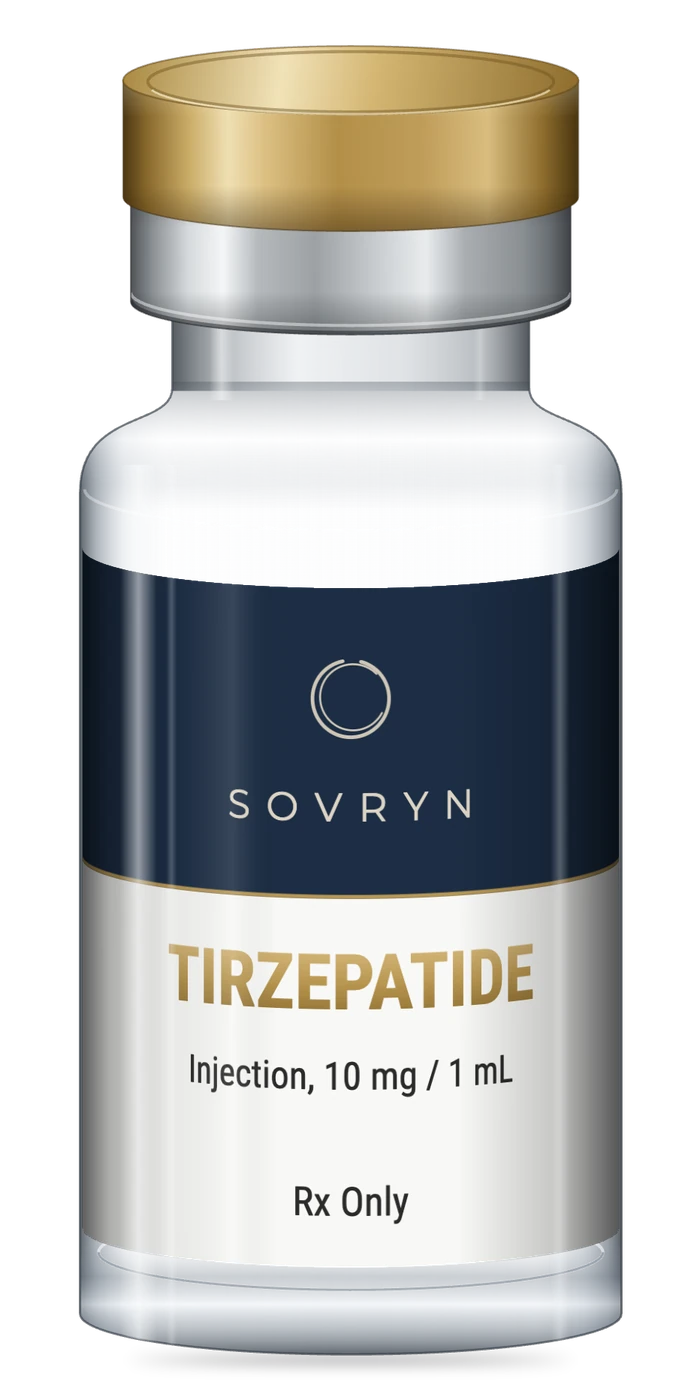
Compounded Tirzepatide
A compounded, once-weekly subcutaneous tirzepatide injection, a dual GIP and GLP-1 receptor agonist. Prescribed at your clinician's discretion and adjusted with you over time.
Monthly total
$429
Care $109 + Medication $320*
Dosing
Set by your clinician and adjusted over time. The price does not change with the dose.
*One monthly price across doses; your clinician sets the dose. Supplies and cold-chain shipping are included. Compounded tirzepatide requires a written prescription from a licensed clinician and is not FDA-approved or evaluated for safety, effectiveness or quality. Evidence standards.
Start Your Assessment →What Is Tirzepatide?
Tirzepatide is a once-weekly injection that activates two gut-hormone receptors, GIP and GLP-1. In published trials of the branded product it produced some of the largest average weight reductions seen with a medication.
Because the effect is hormonal rather than stimulant, it does not build muscle or teach eating patterns. That is why every SOVRYN plan pairs the medication with protein targets, resistance-training guidance and a maintenance or discontinuation plan from the first visit.
Good to Know
- Prescribed only after a clinician reviews your history.
- Dose and course are set by your clinician, not by you.
- Results vary, and we do not promise outcomes.
Who It Is For
Eligibility
Often a Good Fit If
- ✓BMI of 30 or above, or 27 and above with a weight-related condition
- ✓Type 2 diabetes or insulin resistance alongside weight goals
- ✓Plateaued on semaglutide or tolerated it poorly
- ✓Willing to build protein and resistance training into the year
Not Prescribed If
- —Personal or family history of medullary thyroid carcinoma, or MEN 2
- —Pregnancy, breastfeeding or planning pregnancy in the near term
- —History of pancreatitis, gastroparesis or active eating disorder
- —Prior serious hypersensitivity to tirzepatide or its excipients
Read Before You Decide
Key Risks, Stated Plainly
Most side effects are gastrointestinal, dose-related and worst in the days after a step-up. They usually settle. Message your clinician rather than pushing through; a slower titration fixes most of it.
Contact care the same day for
Severe or persistent abdominal pain, repeated vomiting, signs of gallbladder disease, vision changes, or a lump or swelling in the neck. Branded tirzepatide carries a boxed warning for thyroid C-cell tumors based on rodent studies.
What Is Measured
Monitoring requirement: Baseline panel, dose review by response and tolerance, scheduled 90-day reviews.
Baseline Metabolic Panel
Glucose, lipids, kidney and liver markers, and HbA1c before the first dose.
Thyroid Function
Reviewed at baseline alongside your personal and family history.
Weight and Waist Trend
Tracked over weeks, not days. Week-to-week change is uneven.
Tolerance and Symptoms
Nausea, hydration, bowel habit and appetite shape every dose decision.
Protein and Training
Protecting lean mass is part of the plan, not an add-on.
Labs at Review
Repeated at clinician-chosen intervals to see how your body is responding.
A Clearer Path Forward
How Clinicians Review Your Response
You and Your Clinician Look at the Same Data
Symptoms you report, laboratory results and, if you connect one, wearable trends are reviewed together before any change.
A Physician-Led Review Every 90 Days
Included in your monthly price. Your clinician decides whether to continue, adjust the dose, change course or stop.
Clinical Judgment Decides
Measurements inform the decision. They do not make it, and no dashboard changes your dose on its own.
What Is Included in the Monthly Price
- ✓Named, physician-led care team
- ✓Supplies and cold-chain shipping included
- ✓Baseline laboratory panel included in your first care cycle
- ✓Physician-led review every 90 days
- ✓Dose adjusted by your clinician with no change in price
Your Care Sequence
01
Questionnaire
Share your history and goals in about ten minutes. No card required.
02
Video Visit
Meet your clinician for a full 45-minute visit and leave with a written plan.
03
Delivery
If prescribed, medication ships from a licensed pharmacy, cold-chain when required, with supplies.
04
Ongoing Care
Messaging between visits, dose adjustments and a physician-led review every 90 days, included.
Common Questions About Tirzepatide
How Quickly Does Tirzepatide Work?+
Appetite changes are often noticeable within one to two weeks, but weight change is measured in months. In trials the curve was still descending at 72 weeks, and the first eight weeks are mostly about finding a dose you tolerate.
Is Tirzepatide Better Than Semaglutide?+
On average, tirzepatide has produced larger weight reductions in published trials, but "better" depends on tolerance, cost, availability and your history. Some members do better on semaglutide, and switching is a normal part of care.
What Happens If I Stop?+
Appetite returns and, without a maintenance plan, weight regain is common. The withdrawal trial data are clear about this. We build the taper and the maintenance phase in advance rather than treating discontinuation as an exit.
Will I Lose Muscle?+
Some lean mass is lost with any significant weight loss. Adequate protein and resistance training substantially blunt it, which is why protein and training guidance is part of every plan rather than an add-on.
Do I Need Labs First?+
Usually yes: a recent metabolic panel, HbA1c and thyroid function at minimum. If your labs are current we will use them; otherwise we order a draw near you.
Can I Use Insurance?+
Care plans are self-pay and compounded medication is typically not covered. We provide itemized receipts for HSA/FSA and can pursue prior authorization if the branded product is appropriate for you.
Still unsure? Message the care team before you join. No account needed.
Published Research
What the Published Science Shows
~20%
Mean body-weight reduction at 72 weeks on the highest dose in the pivotal obesity trial of branded tirzepatide.
72 wks
Trial duration behind those figures. The curve was still descending at the end, and results build slowly.
1.5 – 2×
Typical advantage over semaglutide on weight endpoints in head-to-head and cross-trial comparisons.
Figures come from the cited trials and reviews. They describe published research, not a forecast for any one person, and not a study of compounded formulations.
The Mechanism
How Tirzepatide Works
Dual Incretin Signaling
One molecule activates both GIP and GLP-1 receptors, producing effects larger than GLP-1 alone in head-to-head data.
Slower Gastric Emptying
Food leaves the stomach more slowly, so meals satisfy for longer and post-meal glucose rises less steeply.
Quieter Food Noise
Signaling in hypothalamic appetite circuits reduces the constant pull toward food that willpower cannot outlast.
Better Insulin Sensitivity
GIP receptor activation appears to improve how adipose tissue handles insulin, alongside glucose-dependent insulin release.
Your First Year
01
Week 1 – 4
Finding Your Footing
What you may notice: Appetite feels different within days for some, a fortnight for others. Mild nausea and fullness after small meals are common.
What is happening: The 2.5 mg starting dose is not a treatment dose. It exists to let your gut adapt. Gastric emptying slows and post-meal glucose curves flatten.
02
Week 4 – 12
Early Change
What you may notice: Most members see the first clear movement on the scale, often two to six pounds a month, plus quieter food thoughts.
What is happening: Doses step up only when the previous one is comfortable. We watch protein intake and hydration closely through this window.
03
Month 3 – 9
The Working Phase
What you may notice: Steady loss, usually uneven week to week. Clothes change before the scale does. Energy improves once protein intake catches up.
What is happening: You settle at the lowest effective dose. Labs are rechecked, and resistance training matters most here to protect lean mass.
04
Month 9 – 12+
Plateau and Maintenance
What you may notice: Loss slows and stabilizes, a normal endpoint and not a failure. Your clinician reviews whether to hold, adjust or begin a taper.
What is happening: Trial curves were still descending at 72 weeks. We plan maintenance or a structured taper in advance, because regain after abrupt discontinuation is well documented.
For Readers Who Want More
Deeper Evidence
What We Can and Cannot Tell YouEvidence and regulatory status+
What the Evidence Supports
Branded tirzepatide has large randomized trials in adults with overweight or obesity and is FDA-approved for chronic weight management in that population.
What It Does Not (Yet)
Those trials studied the branded product, not compounded formulations, which the FDA has not evaluated for safety, effectiveness or quality.
Badge definitions and FDA category sourcing are on the Science page.
Illustrative Dose ScheduleFinal dose set by your clinician+
Illustrative only. Doses step up only when the previous one is comfortable, and your clinician selects and reviews your dose according to response and tolerance, not the highest one on the label. This table is not a prescription.
| Phase | Weekly Dose | Typical Duration | What We Watch |
|---|---|---|---|
| Initiation | 2.5 mg | 4 weeks | Nausea, hydration, protein intake |
| First step-up | 5 mg | 4+ weeks | Appetite response, bowel habit |
| Optimization | 7.5 – 10 mg | 8 – 24 weeks | Rate of loss, lean-mass markers |
| Maximum | 12.5 – 15 mg | As indicated | Only if needed and tolerated |
| Maintenance / taper | Lowest effective | Ongoing | Weight stability, habits, labs |
Compounded Versus Brand-NameWhat “compounded” means+
| Compounded | Brand-Name |
|---|---|
| Prepared per prescription | Manufactured at scale |
| Not FDA-approved | FDA-approved indications |
| Flexible dosing in vials | Fixed pen doses |
| Lower typical cost | Insurance may apply |
Compounded medications are prepared by a licensed pharmacy for an individual patient. We will tell you when the branded product is the better choice for your situation.
Selected Studies
Jastreboff et al., New England Journal of Medicine, 2022 (SURMOUNT-1)
Once-weekly tirzepatide in adults with obesity produced substantial, dose-dependent weight reduction at 72 weeks compared with placebo.
Frías et al., New England Journal of Medicine, 2021 (SURPASS-2)
In type 2 diabetes, tirzepatide improved glycemic control and weight versus semaglutide.
Aronne et al., JAMA, 2024 (SURMOUNT-4)
Stopping tirzepatide led to substantial weight regain, which is why maintenance is planned in advance.
See Whether Tirzepatide Is Right for You
Ten minutes, no card, reviewed by a clinician.