
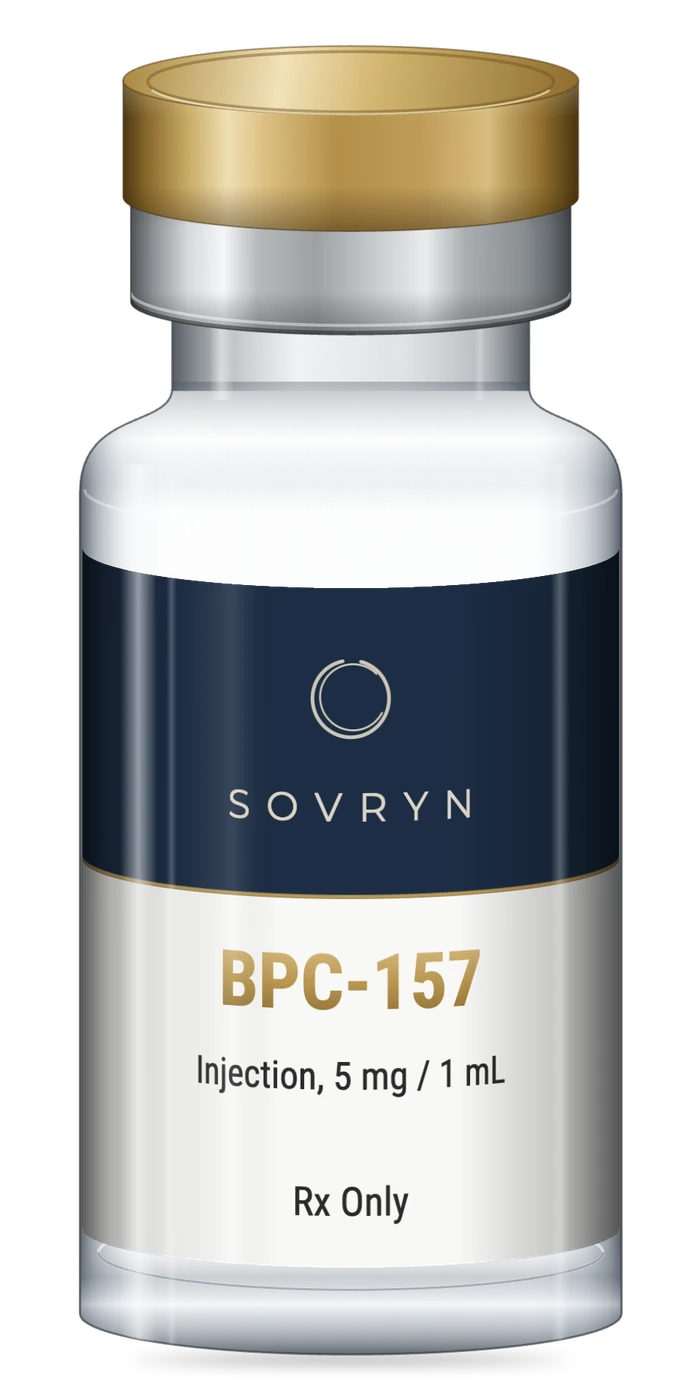
BPC-157
A synthetic peptide fragment studied for soft-tissue and gastrointestinal repair, run as a defined 8–12 week course with a clear endpoint and reviewed against your symptoms rather than renewed by default.
Monthly total
$249
Care $109 + Medication $140*
Dosing
Set by your clinician for a defined 8–12 week course. The price does not change with the dose.
*One monthly price; your clinician sets the dose and course length. Supplies and cold-chain shipping are included. BPC-157 requires a written prescription from a licensed clinician. It is not FDA-approved and is not evaluated for safety, effectiveness or quality. Availability may change. Evidence standards.
Start Your Assessment →What Is BPC-157?
BPC-157 is a synthetic fragment of a peptide first identified in gastric juice. It has been studied in animal and cell models for tendon, ligament and gut repair.
It has not been through the large randomized human trials that back a drug like tirzepatide. We run it as a defined course with a clear endpoint, and we tell you that plainly before you decide.
Good to Know
- Prescribed only after a clinician reviews your history.
- Dose and course are set by your clinician, not by you.
- Results vary, and we do not promise outcomes.
Who It Is For
Eligibility
Competitive Athletes
BPC-157 is on the 2026 WADA Prohibited List. A prescription does not establish sporting eligibility, so we ask about anti-doping rules before presenting any option.
Often a Good Fit If
- ✓A tendon, ligament or gut complaint that has not resolved with standard care
- ✓Willing to pair it with physical therapy or a structured return-to-training plan
- ✓Comfortable with limited long-term human safety data
- ✓No pregnancy, active malignancy or known hypersensitivity
Not Prescribed If
- —Pregnancy, breastfeeding, or actively trying to conceive
- —Active or recent cancer diagnosis
- —Expecting a guaranteed or fast outcome rather than a considered trial
- —Not open to a defined course with a clinician-reviewed endpoint
- —Subject to anti-doping rules that prohibit it
Read Before You Decide
Key Risks, Stated Plainly
Reported side effects in the limited available data are mostly mild: injection-site irritation, occasional nausea, fatigue or headache. There is no large long-term human safety record, so we ask you to report anything unusual right away, and we will stop a course early if something does not look right. BPC-157 is also on FDA's Category 2 review list, an interim compounding-policy flag that is not proof of harm.
Contact care the same day for
Significant swelling or pain at an injection site, signs of allergic reaction, or any new or unexplained symptom during your course.
What Is Measured
Monitoring requirement: Defined course with a reassessment point; sport-rule check for competitive athletes.
Function and Pain
A baseline you rate at the start, then again at each check-in.
Training Load
What you can do, compared with what you could before the injury.
Injection-Site Tolerance
Reviewed early, when most reactions appear.
Anti-Doping Check
Competitive athletes are screened against current sport rules first.
Course Endpoint
A scheduled reassessment at weeks eight to twelve against your original goal.
A Clearer Path Forward
How Clinicians Review Your Response
You and Your Clinician Look at the Same Data
Symptoms you report, laboratory results and, if you connect one, wearable trends are reviewed together before any change.
A Physician-Led Review Every 90 Days
Included in your monthly price. Your clinician decides whether to continue, adjust the dose, change course or stop.
Clinical Judgment Decides
If it is not helping by week eight, the plan changes. We do not renew by default.
What Is Included in the Monthly Price
- ✓Named, physician-led care team
- ✓Supplies and cold-chain shipping included
- ✓Baseline laboratory panel included in your first care cycle
- ✓Physician-led review every 90 days
- ✓Dose adjusted by your clinician with no change in price
Your Care Sequence
01
Questionnaire
Share your injury or goal in about ten minutes. No card required.
02
Video Visit
Meet your clinician to confirm it is a reasonable fit, check sport rules if you compete, and set the course length.
03
Delivery
If prescribed, medication ships cold-chain from a licensed pharmacy with supplies.
04
Reassessment
A check-in at week eight to twelve decides whether to stop, extend, or change course.
Common Questions About BPC-157
Is BPC-157 FDA-Approved?+
No. It is not an FDA-approved drug, and compounded BPC-157 is not evaluated by the FDA for safety, effectiveness or quality. It also appears on FDA's Category 2 safety-risk review list, an interim compounding-policy flag, not a ban, but a reason we monitor it closely. See our evidence standards on the Science page.
Why Is the Evidence "Largely Preclinical"?+
Most of what we know about BPC-157's mechanism and effects comes from animal and cell-culture studies, not large human randomized trials. That does not mean it does nothing. It means the human data are thin, and we say so before you start.
What Does a Course Actually Treat?+
Stubborn tendon, ligament or gut complaints that have not resolved with standard care, such as a nagging Achilles or elbow tendinopathy, or a training injury that has plateaued. It is a considered option, not a substitute for physical therapy, imaging, or a surgical opinion when one is warranted.
How Long Does a Course Run?+
Typically 8 to 12 weeks with a defined endpoint. We do not renew by default; your clinician reassesses against your symptoms and training load, not the calendar.
What Are the Side Effects?+
Reported side effects in the limited available data are mostly mild: injection-site irritation, occasional nausea or headache. Because long-term human safety data is limited, we ask you to report anything unusual promptly.
Can I Combine It With Other Treatments?+
Sometimes, for example alongside a GLP-1 plan or a longevity panel. Your clinician reviews your full medication list first; some combinations simply have not been studied together, which is itself a reason for caution.
Still unsure? Message the care team before you join. No account needed.
Published Research
What the Published Science Shows
35 of 36
Studies in the 2025 systematic review of BPC-157 that were preclinical. One was clinical.
7 of 12
Patients in the one clinical study in that review who reported relief of chronic knee pain for more than six months. It was retrospective, with no control group.
0
Clinical safety studies found in that review. Preclinical safety studies showed no adverse effects across several organ systems.
Figures come from the cited trials and reviews. They describe published research, not a forecast for any one person, and not a study of compounded formulations.
The Mechanism
The Proposed Mechanism
Angiogenesis
The leading proposed mechanism: new blood vessel growth toward injured tissue, which in animal models has sped healing of tendon, ligament and gut lesions.
Collagen Signaling
Preclinical work suggests BPC-157 upregulates collagen and growth-factor pathways involved in tissue repair.
Local Inflammatory Tone
Animal studies report a calmer local inflammatory response at the injury site, alongside the repair signaling above.
For Readers Who Want More
Deeper Evidence
What We Can and Cannot Tell YouEvidence and regulatory status+
What the Evidence Supports
A mechanistically reasonable case for soft-tissue and gut repair, built on consistent findings across multiple animal models. Anecdotal reports from clinical use are broadly favorable and reported side effects are mild.
What It Does Not (Yet)
No large, published human randomized controlled trials establishing efficacy or long-term safety. It is on FDA's Category 2 safety-risk review list, so we treat it as monitored rather than routine.
Badge definitions and FDA category sourcing are on the Science page.
Illustrative Course StructureFinal dose set by your clinician+
Illustrative only, not a prescription. We run BPC-157 as a bounded course with a scheduled reassessment, not an open-ended subscription.
| Phase | Typical Dose | Duration | What We Watch |
|---|---|---|---|
| Loading | 250 – 500 mcg once or twice daily | Weeks 1 – 2 | Injection-site tolerance, symptom trend |
| Course | Held at the tolerated dose | Weeks 3 – 8 | Function, pain, training load |
| Reassessment | Clinician review; extend, stop, or taper | Week 8 – 12 | Whether the goal was met |
Selected Studies
Vasireddi et al., HSS Journal, 2025 (systematic review of BPC-157)
Of 36 studies, 35 were preclinical and 1 was clinical. Animal work reports better muscle, tendon, ligament and bone healing outcomes. No clinical safety data were found, and the authors advise caution and counseling for athletes.
Read the Source ↗Lee and Padgett, 2021 (PMID 34324435), retrospective knee-pain chart review
Sixteen patients with knee pain reached by phone after an injection. Twelve had BPC-157 alone and four had BPC-157 with thymosin beta-4. Most self-reported relief. There was no control group and no objective measures. It is the only human report we found that includes the pair.
Read the Source ↗Lee, Walker and Ayadi, 2024 (PMID 39325560), pilot study
Twelve women with interstitial cystitis received a single BPC-157 injection around the bladder and reported symptom relief. It was uncontrolled and is not a musculoskeletal study.
Read the Source ↗Often Considered Together
Paired With
See Whether BPC-157 Is Worth Considering
Ten minutes, no card, reviewed by a clinician.