
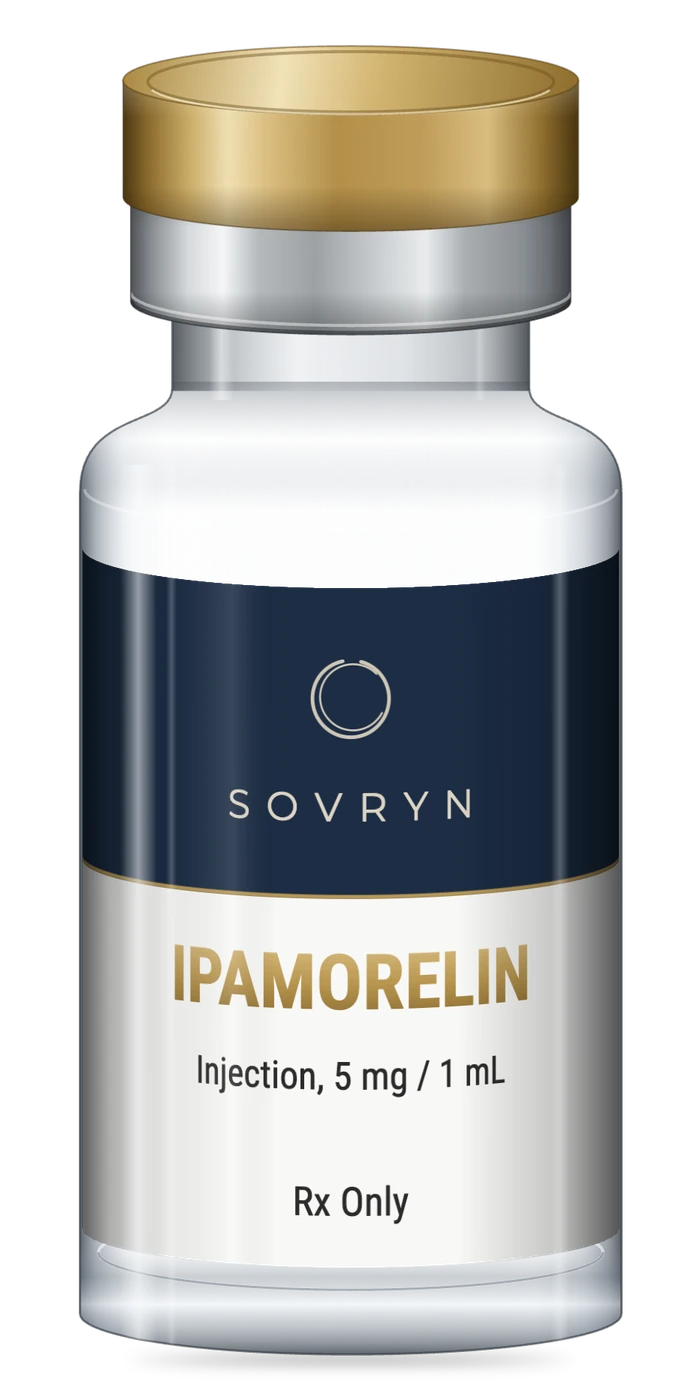
Ipamorelin
A selective growth hormone secretagogue that releases growth hormone through the ghrelin receptor. It was developed as a drug, and its one published Phase 2 trial in people did not meet its goals.
How it is offered
Priced With Your Plan
Pricing
Your clinician sets the plan. Pricing is shown before you authorize any charge.
Ipamorelin requires a written prescription from a licensed clinician and is prepared by a licensed pharmacy for an individual patient. Compounded medications are not FDA-approved or evaluated for safety, effectiveness or quality. Evidence standards.
Start Your Assessment →What Is Ipamorelin?
Ipamorelin is a five-amino-acid peptide described in 1998 as the first selective growth hormone secretagogue. It releases growth hormone through a ghrelin-type receptor, shown in cells and animals.
Its main human trial tested it for a different problem, bowel recovery after surgery, and found no significant benefit. We describe that plainly. It is often combined with CJC-1295.
Good to Know
- Prescribed only after a clinician reviews your history.
- Dose and course are set by your clinician, not by you.
- Results vary, and we do not promise outcomes.
Who It Is For
Eligibility
Competitive Athletes
Growth-hormone-releasing peptides and secretagogues are on the WADA Prohibited List at all times. A prescription does not establish sporting eligibility, so we ask about anti-doping rules before presenting any option.
Often a Good Fit If
- ✓Adults with persistent sleep, recovery or body-composition concerns after the basics are addressed
- ✓Comfortable with very limited human evidence for these goals
- ✓Willing to complete baseline labs and repeat them
- ✓Open to a defined course with a clinician-reviewed endpoint
Not Prescribed If
- —Pregnancy, breastfeeding, or actively trying to conceive
- —Active or recent cancer diagnosis, or a history your clinician judges to carry risk
- —Expecting a guaranteed or fast outcome rather than a considered trial
- —Uncontrolled diabetes or significant glucose intolerance
- —A pituitary or hypothalamic disorder, unless directed by a specialist
- —Subject to anti-doping rules that prohibit it
Read Before You Decide
Key Risks, Stated Plainly
In the Phase 2 trial, intravenous ipamorelin for up to seven days was well tolerated, and adverse events occurred at similar rates to placebo (87.5% versus 94.8% in a surgical population where complications are common). That setting and route differ from outpatient injections, so it says little about the long-term safety of this use. Ipamorelin sits on FDA's Category 2 review list, an interim compounding-policy flag.
Contact care the same day for
Significant swelling, signs of allergic reaction, chest discomfort, shortness of breath, or any new or unexplained symptom during a course.
What Is Measured
IGF-1
Measured at baseline and during the course.
Fasting Glucose and HbA1c
Growth hormone can affect glucose handling.
Sleep and Recovery
Your own reports and, if you connect one, wearable trends.
Tolerance
Injection sites and symptoms, reviewed early.
Anti-Doping Check
Competitive athletes are screened against current sport rules first.
A Clearer Path Forward
How Clinicians Review Your Response
You and Your Clinician Look at the Same Data
Symptoms you report, laboratory results and, if you connect one, wearable trends are reviewed together before any change.
A Physician-Led Review Every 90 Days
Included in your monthly price. Your clinician decides whether to continue, adjust the dose, change course or stop.
Clinical Judgment Decides
Measurements inform the decision. They do not make it, and no dashboard changes your dose on its own.
Your Care Sequence
01
Questionnaire
Share your goals, history and any sport or work rules in about ten minutes. No card required.
02
Video Visit
Your clinician reviews your history and medications, explains the evidence plainly, and decides whether this fits you.
03
Delivery
If prescribed, medication ships from a licensed pharmacy with supplies and written instructions.
04
Reassessment
A scheduled review decides whether to stop, extend or change course. Courses are not renewed by default.
Common Questions About Ipamorelin
What Did the Phase 2 Trial Show?+
In 117 adults after bowel resection, ipamorelin was well tolerated, but the median time to first tolerated meal (25.3 hours versus 32.6 hours with placebo) was not significantly different (p = 0.15). The primary endpoint was not met. The trial studied bowel recovery, not sleep, recovery or body composition.
Is There Human Evidence for Sleep or Body Composition?+
We did not find a published controlled trial of ipamorelin for those goals. The original 1998 paper showed it releases growth hormone in cells and animals.
Is Ipamorelin FDA-Approved?+
No. It is not an FDA-approved drug, and compounded ipamorelin is not evaluated by the FDA for safety, effectiveness or quality.
Can I Use It If I Compete in Sport?+
Probably not. Growth hormone secretagogues are prohibited by WADA at all times, and a prescription does not change that.
Is It Available Through SOVRYN?+
Ipamorelin is prescribed only after a clinician reviews your history and decides it fits. Start with the assessment and your clinician will tell you what is and is not appropriate.
Still unsure? Message the care team before you join. No account needed.
Published Research
What the Published Science Shows
117
Adults in the one published Phase 2 trial of ipamorelin, studied after bowel surgery.
25.3 vs 32.6 h
Median time to first tolerated meal with ipamorelin versus placebo.
p = 0.15
The difference was not statistically significant, and the primary endpoint was not met.
Figures come from the cited trials and reviews. They describe published research, not a forecast for any one person, and not a study of compounded formulations.
The Mechanism
How It Is Proposed to Work
Ghrelin-Receptor Secretagogue
It stimulates a receptor that drives pulses of growth hormone release.
Selective
The 1998 paper described it as the first selective growth hormone secretagogue.
Downstream IGF-1
Growth hormone raises IGF-1 from the liver, which is why IGF-1 is the main lab we monitor.
For Readers Who Want More
Deeper Evidence
What We Can and Cannot Tell YouEvidence and regulatory status+
What the Evidence Supports
A clear mechanism: it releases growth hormone through the ghrelin receptor, shown in cells and animals, and it was well tolerated in a 117-patient Phase 2 trial.
What It Does Not (Yet)
No significant benefit in that trial, no published controlled trial for sleep, recovery or body composition, and limited long-term safety data. It is on the WADA Prohibited List.
Badge definitions and FDA category sourcing are on the Science page.
Illustrative Course StructureFinal dose set by your clinician+
Illustrative only and not a prescription. Dose, timing and length are set by your clinician and the compounding pharmacy.
| Phase | Approach | Duration | What We Watch |
|---|---|---|---|
| Baseline | Visit, labs where indicated | Before starting | Symptoms, relevant labs |
| Course | Clinician-set dose, held at the tolerated level | Defined by your clinician | Tolerance, response |
| Reassessment | Extend, stop or change course | At the scheduled review | Whether the goal was met |
Selected Studies
Raun et al., European Journal of Endocrinology, 1998
The paper that first described ipamorelin as a selective growth hormone secretagogue, with GH-releasing potency shown in cells and in animals.
Read the Source ↗Beck et al., International Journal of Colorectal Disease, 2014 (Phase 2 trial)
In 117 adults after bowel resection, intravenous ipamorelin for up to 7 days was well tolerated, but median time to first tolerated meal (25.3 hours versus 32.6 hours with placebo) did not differ significantly (p = 0.15). The primary endpoint was not met.
Read the Source ↗Renke and Chinellato, International Journal of Molecular Sciences, 2026 (review of 106 articles)
Reviewed the effects, safety and regulatory status of prominent therapeutic peptides, including unapproved ones, and concluded that further studies are needed before most new peptides can be used safely in humans.
Read the Source ↗
Start Your Assessment for Growth Hormone Pathway Options
Ten minutes, no card, reviewed by a clinician.