
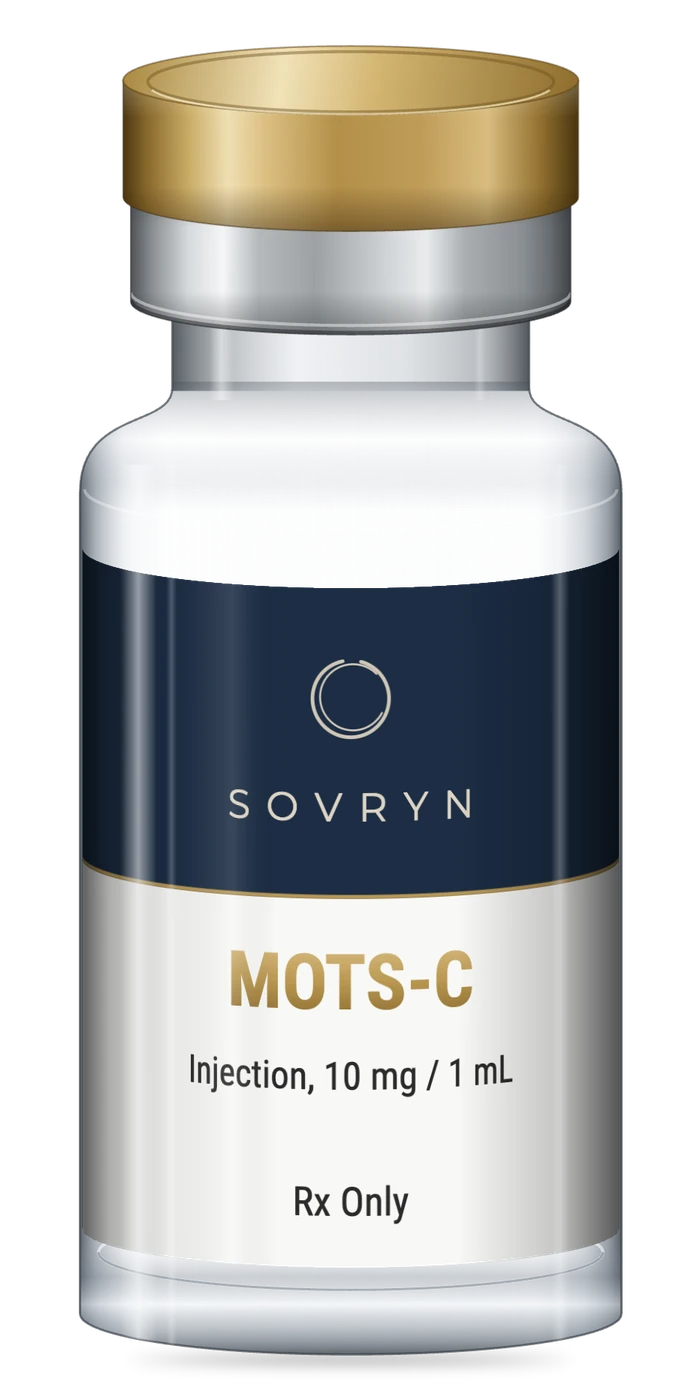
MOTS-c
A 16-amino-acid peptide encoded in mitochondrial DNA. In mice it prevented diet-induced obesity and improved physical performance. We found no controlled trial of injected MOTS-c in people.
How it is offered
Priced With Your Plan
Pricing
Your clinician sets the plan. Pricing is shown before you authorize any charge.
MOTS-c requires a written prescription from a licensed clinician and is prepared by a licensed pharmacy for an individual patient. Compounded medications are not FDA-approved or evaluated for safety, effectiveness or quality. Evidence standards.
Start Your Assessment →What Is MOTS-c?
MOTS-c was identified in 2015 as a short peptide made from the mitochondrial genome, not the nuclear one. In mice it regulated insulin sensitivity and metabolism, with muscle as its main target.
A 2021 study found that in people, exercise raises the body's own MOTS-c in muscle and blood, and that treated mice, including old ones, performed better. Neither tested injected MOTS-c in humans, which is the question that matters here.
Good to Know
- Prescribed only after a clinician reviews your history.
- Dose and course are set by your clinician, not by you.
- Results vary, and we do not promise outcomes.
Who It Is For
Eligibility
Competitive Athletes
Many peptides are prohibited in sport, or fall under rules that change. A prescription does not establish sporting eligibility, so we ask about anti-doping rules before presenting any option.
Often a Good Fit If
- ✓Interested in metabolic health and comfortable with mouse-level evidence
- ✓A recent metabolic panel and HbA1c
- ✓Already working on nutrition, activity and sleep
- ✓Open to stopping if there is no measurable or subjective benefit
Not Prescribed If
- —Pregnancy, breastfeeding, or actively trying to conceive
- —Active or recent cancer diagnosis, or a history your clinician judges to carry risk
- —Expecting a guaranteed or fast outcome rather than a considered trial
- —Type 1 diabetes or insulin use, unless your specialist directs it
- —Prior serious hypersensitivity to MOTS-c or its excipients
Read Before You Decide
Key Risks, Stated Plainly
There is no human safety record for injected MOTS-c that we could find. Because it is studied as a regulator of glucose metabolism, we review your glucose, medications and any diabetes treatment first. MOTS-c sits on FDA's Category 2 safety-risk page.
Contact care the same day for
Symptoms of low blood sugar such as shakiness, sweating or confusion, significant swelling or pain at an injection site, signs of allergic reaction, or any new or unexplained symptom during a course.
What Is Measured
Fasting Glucose, Insulin and HbA1c
Baseline and repeat, to see whether anything changes.
Weight and Waist Trend
Tracked over weeks, not days.
Energy and Exercise Tolerance
Your own reports, compared with baseline.
Medications
Reviewed first, especially glucose-lowering drugs.
Course Endpoint
A scheduled reassessment against your original goal.
A Clearer Path Forward
How Clinicians Review Your Response
You and Your Clinician Look at the Same Data
Symptoms you report, laboratory results and, if you connect one, wearable trends are reviewed together before any change.
A Physician-Led Review Every 90 Days
Included in your monthly price. Your clinician decides whether to continue, adjust the dose, change course or stop.
Clinical Judgment Decides
Measurements inform the decision. They do not make it, and no dashboard changes your dose on its own.
Your Care Sequence
01
Questionnaire
Share your goals, history and any sport or work rules in about ten minutes. No card required.
02
Video Visit
Your clinician reviews your history and medications, explains the evidence plainly, and decides whether this fits you.
03
Delivery
If prescribed, medication ships from a licensed pharmacy with supplies and written instructions.
04
Reassessment
A scheduled review decides whether to stop, extend or change course. Courses are not renewed by default.
Common Questions About MOTS-c
What Did the Mouse Studies Show?+
In mice, MOTS-c prevented age-dependent and high-fat-diet-induced insulin resistance and diet-induced obesity. In a later study it improved physical performance in young, middle-aged and old mice.
Has It Been Tested in People?+
Exercise raises the body's own MOTS-c in people. We found no published controlled trial of injected MOTS-c for weight, glucose or performance.
Is MOTS-c FDA-Approved?+
No. It is not an FDA-approved drug, and it appears on FDA's Category 2 safety-risk page.
Is It Available Through SOVRYN?+
MOTS-c is prescribed only after a clinician reviews your history and decides it fits. Start with the assessment and your clinician will tell you what is and is not appropriate.
Still unsure? Message the care team before you join. No account needed.
Published Research
What the Published Science Shows
16
Amino acids in MOTS-c, encoded in the mitochondrial 12S rRNA gene.
3×/week
Intermittent MOTS-c in late-life mice increased physical capacity and healthspan in the 2021 study.
0
Controlled trials of injected MOTS-c in people that we found.
Figures come from the cited trials and reviews. They describe published research, not a forecast for any one person, and not a study of compounded formulations.
The Mechanism
The Proposed Mechanism
Mitochondrial Signal
It is encoded in the mitochondrial genome and acts as a signal from the mitochondria to the rest of the cell.
Muscle and AMPK
In mice its main target is skeletal muscle, where it inhibits the folate cycle and activates AMPK.
Exercise-Induced
In people, exercise raises endogenous MOTS-c in muscle and the circulation.
For Readers Who Want More
Deeper Evidence
What We Can and Cannot Tell YouEvidence and regulatory status+
What the Evidence Supports
A defined mechanism (AMPK activation via the folate cycle in muscle), consistent mouse findings on obesity, insulin resistance and performance, and the observation that exercise raises human MOTS-c.
What It Does Not (Yet)
No controlled trial of injected MOTS-c in people, no established dose or long-term safety, and no evidence it produces weight loss or performance gains in humans.
Badge definitions and FDA category sourcing are on the Science page.
Illustrative Course StructureFinal dose set by your clinician+
Illustrative only and not a prescription. Dose, timing and length are set by your clinician and the compounding pharmacy.
| Phase | Approach | Duration | What We Watch |
|---|---|---|---|
| Baseline | Visit, labs where indicated | Before starting | Symptoms, relevant labs |
| Course | Clinician-set dose, held at the tolerated level | Defined by your clinician | Tolerance, response |
| Reassessment | Extend, stop or change course | At the scheduled review | Whether the goal was met |
Selected Studies
Lee et al., Cell Metabolism, 2015
Identified MOTS-c, a 16-amino-acid peptide encoded in mitochondrial DNA. In mice, MOTS-c treatment prevented age-dependent and high-fat-diet-induced insulin resistance and diet-induced obesity.
Read the Source ↗Reynolds et al., Nature Communications, 2021
In young, middle-aged and old mice, MOTS-c improved physical performance, and late-life intermittent treatment increased physical capacity and healthspan. In humans, exercise raised the body's own MOTS-c in muscle and blood. It did not test injected MOTS-c in people.
Read the Source ↗Renke and Chinellato, International Journal of Molecular Sciences, 2026 (review of 106 articles)
Reviewed the effects, safety and regulatory status of prominent therapeutic peptides, including unapproved ones, and concluded that further studies are needed before most new peptides can be used safely in humans.
Read the Source ↗
Start Your Assessment for Metabolic and Energy Options
Ten minutes, no card, reviewed by a clinician.