
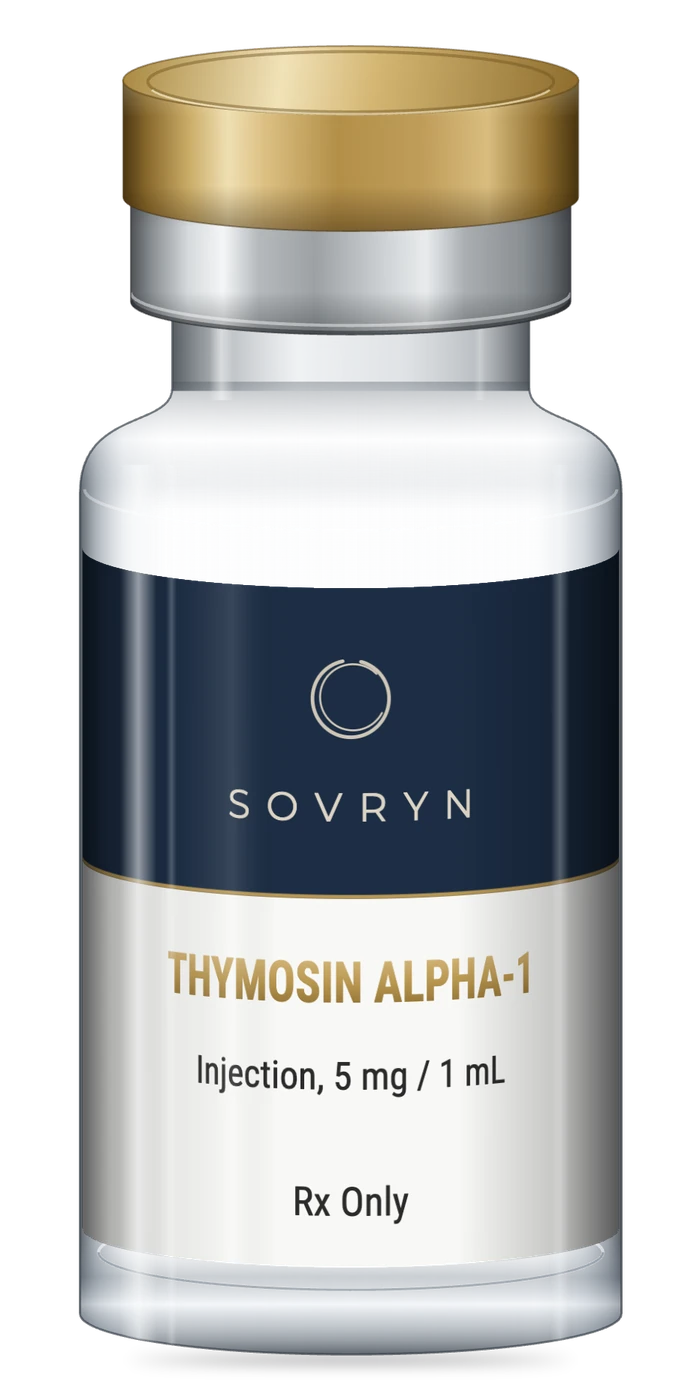
Thymosin Alpha-1
A 28-amino-acid thymic peptide studied as an immune modulator. It is marketed as Zadaxin in some countries outside the US and is not FDA-approved. Its best human data are in severe sepsis, where the main result was borderline.
How it is offered
Priced With Your Plan
Pricing
Your clinician sets the plan. Pricing is shown before you authorize any charge.
Thymosin alpha-1 requires a written prescription from a licensed clinician and is prepared by a licensed pharmacy for an individual patient. Compounded medications are not FDA-approved or evaluated for safety, effectiveness or quality. Evidence standards.
Start Your Assessment →What Is Thymosin Alpha-1?
Thymosin alpha-1 is a peptide originally isolated from the thymus, a gland central to immune development. It is studied as an immune modulator that helps activate and restore a dysregulated immune response.
Its strongest human data come from hospital trials in severe sepsis, a very different setting from outpatient use. In the largest, the main result was borderline. Outpatient use for wellness is not supported by controlled trials we found.
Good to Know
- Prescribed only after a clinician reviews your history.
- Dose and course are set by your clinician, not by you.
- Results vary, and we do not promise outcomes.
Who It Is For
Eligibility
Competitive Athletes
Many peptides are prohibited in sport, or fall under rules that change. A prescription does not establish sporting eligibility, so we ask about anti-doping rules before presenting any option.
Often a Good Fit If
- ✓A clinician-identified reason to consider an immune modulator
- ✓Comfortable with limited evidence outside hospital settings
- ✓A clear medication list and history, including any autoimmune disease
- ✓Open to a defined course with a clinician-reviewed endpoint
Not Prescribed If
- —Pregnancy, breastfeeding, or actively trying to conceive
- —Active or recent cancer diagnosis, or a history your clinician judges to carry risk
- —Expecting a guaranteed or fast outcome rather than a considered trial
- —An autoimmune condition or organ transplant, unless directed by the treating specialist
- —Taking immunosuppressive medication, unless directed by the treating specialist
- —Prior serious hypersensitivity to thymosin alpha-1 or its excipients
Read Before You Decide
Key Risks, Stated Plainly
In the ETASS trial of 361 patients with severe sepsis, no serious drug-related adverse events were recorded. That was a hospital trial of critically ill patients, so it says little about outpatient use. Because the peptide acts on the immune system, anyone with an autoimmune condition, a transplant or on immunosuppressants is excluded unless their specialist directs otherwise.
Contact care the same day for
Fever, signs of infection, signs of allergic reaction, significant swelling or pain at an injection site, or any new or unexplained symptom during a course.
What Is Measured
Medical History and Medications
Reviewed first, especially autoimmune disease and immunosuppressants.
Relevant Labs
Selected by your clinician for your situation.
Infections and Symptoms
Your own reports at each check-in.
Course Endpoint
A scheduled reassessment against your original goal.
A Clearer Path Forward
How Clinicians Review Your Response
You and Your Clinician Look at the Same Data
Symptoms you report, laboratory results and, if you connect one, wearable trends are reviewed together before any change.
A Physician-Led Review Every 90 Days
Included in your monthly price. Your clinician decides whether to continue, adjust the dose, change course or stop.
Clinical Judgment Decides
Measurements inform the decision. They do not make it, and no dashboard changes your dose on its own.
Your Care Sequence
01
Questionnaire
Share your goals, history and any sport or work rules in about ten minutes. No card required.
02
Video Visit
Your clinician reviews your history and medications, explains the evidence plainly, and decides whether this fits you.
03
Delivery
If prescribed, medication ships from a licensed pharmacy with supplies and written instructions.
04
Reassessment
A scheduled review decides whether to stop, extend or change course. Courses are not renewed by default.
Common Questions About Thymosin Alpha-1
Is Thymosin Alpha-1 FDA-Approved?+
Not in the United States. It is marketed as Zadaxin in some other countries. Compounded thymosin alpha-1 here is not FDA-approved or evaluated for safety, effectiveness or quality.
What Did the Sepsis Trial Show?+
In 361 patients with severe sepsis, 28-day mortality was 26.0% with thymosin alpha 1 versus 35.0% with control (relative risk 0.74, 95% CI 0.54 to 1.02; p = 0.062). Immune markers improved. The primary result did not reach conventional significance.
Does That Apply to Healthy People?+
No. The trial studied critically ill hospital patients. We found no controlled trial supporting outpatient use for general wellness.
Is It Available Through SOVRYN?+
Thymosin alpha-1 is prescribed only after a clinician reviews your history and decides it fits. Start with the assessment and your clinician will tell you what is and is not appropriate.
Still unsure? Message the care team before you join. No account needed.
Published Research
What the Published Science Shows
361
Patients with severe sepsis in the ETASS randomized trial.
26.0% vs 35.0%
28-day mortality with thymosin alpha 1 versus control.
p = 0.062
Relative risk 0.74 (95% CI 0.54 to 1.02). Borderline, not conventionally significant.
Figures come from the cited trials and reviews. They describe published research, not a forecast for any one person, and not a study of compounded formulations.
The Mechanism
The Proposed Mechanism
Immune Modulation
Reviews describe it as activating and restoring a dysregulated immune response.
Monocyte Function
In the sepsis trial, markers of monocyte immune function recovered more with treatment.
For Readers Who Want More
Deeper Evidence
What We Can and Cannot Tell YouEvidence and regulatory status+
What the Evidence Supports
A randomized, multicenter trial of 361 sepsis patients showing lower 28-day mortality that was borderline, improved immune-marker recovery, and no serious drug-related adverse events.
What It Does Not (Yet)
The main result did not reach conventional significance, the trial was in critically ill patients, and controlled evidence for outpatient or wellness use is absent.
Badge definitions and FDA category sourcing are on the Science page.
Illustrative Course StructureFinal dose set by your clinician+
Illustrative only and not a prescription. Dose, timing and length are set by your clinician and the compounding pharmacy.
| Phase | Approach | Duration | What We Watch |
|---|---|---|---|
| Baseline | Visit, labs where indicated | Before starting | Symptoms, relevant labs |
| Course | Clinician-set dose, held at the tolerated level | Defined by your clinician | Tolerance, response |
| Reassessment | Extend, stop or change course | At the scheduled review | Whether the goal was met |
Selected Studies
Wu et al., Critical Care, 2013 (ETASS trial)
In 361 patients with severe sepsis in six Chinese hospitals, 28-day mortality was 26.0% with thymosin alpha 1 versus 35.0% with control (relative risk 0.74, 95% CI 0.54 to 1.02; p = 0.062). Immune markers improved, and no serious drug-related adverse events were recorded. The primary result did not reach conventional significance.
Read the Source ↗Pei, Guan and Wu, Expert Opinion on Biological Therapy, 2018 (review)
Reviews thymosin alpha 1 as an immune modulator that activates and restores a dysregulated immune response in sepsis.
Read the Source ↗Renke and Chinellato, International Journal of Molecular Sciences, 2026 (review of 106 articles)
Reviewed the effects, safety and regulatory status of prominent therapeutic peptides, including unapproved ones, and concluded that further studies are needed before most new peptides can be used safely in humans.
Read the Source ↗
Start Your Assessment for Immune Support Options
Ten minutes, no card, reviewed by a clinician.